
Gutter guard maintenance is lighter than cleaning open gutters, but it is not zero. For most Sussex County homes, that means a rinse and a look once a year after the leaves are down, more often under pine trees, and a quick check after every big storm. If you do that, your guards will keep doing their job for years.
This guide explains what builds up on guards here, how to tell which type you have, how to clean them safely, and the signs that a guard needs repair rather than just a rinse.
Do Gutter Guards Need to Be Cleaned?
Yes. A gutter guard stops leaves, twigs and pine cones from getting into the gutter, which is where clogs used to form. But anything small enough, or anything that sits on top long enough, still has to go somewhere.
We install two systems, LeafBlaster Pro and Gutterglove, and the honest answer is the same for both: no guard is completely maintenance-free, whatever the brand. How much care your guards need depends far more on what grows around your house than on the label on the guard. A house under tall pines will always need more attention than one on an open lot near the beach.
The good news is that the work changes. Instead of scooping wet leaves out of a gutter on a ladder twice a year, most guard owners only need to clear what sits on top and rinse the surface now and then.
What Ends Up on Gutter Guards in Sussex County
What collects on your guards depends on where you live in the county, and on the time of year.
-
Pine needles, all year. Loblolly pines are everywhere here, inland and near the coast. Their needles are long and thin, so they can lie flat across a guard or work their way into gaps at the ends and corners.
-
Oak and maple leaves, late October through November. Inland neighborhoods around Selbyville, Millsboro and Ocean View get the heaviest leaf fall. Wet leaves can mat together on top of a guard and block water like a lid.
-
Yellow pollen, in spring. Every spring, pine pollen coats cars, decks and roofs. On a fine mesh guard it can leave a film that slows water down.
-
Sand and roof grit. Near the beaches, wind carries fine sand onto roofs. Older asphalt shingles also shed grit. Both are fine enough to sit in the mesh.
-
Salt air and nor’easters. Salt in the air is hard on metal fasteners and frames over time, and strong winds can lift the edge of a guard or loosen its screws. Nor’easters are most frequent from September through April, so that is when guards take the most wind.
Which Gutter Guard Do You Have?
Cleaning advice depends on the type of guard, so it helps to know which one is on your house. Most can be identified from the ground, or with binoculars.
-
Fine mesh (micro-mesh): a very fine metal mesh, often stainless steel, held in an aluminum frame that sits flat or at a slight angle over the gutter. Both systems we install are this type.
-
Screen: a metal or plastic grid with holes you can see clearly from a ladder, usually laid flat over the gutter.
-
Reverse curve (hood): a solid cover that curves over the front edge of the gutter, with a narrow slot where water follows the curve in. From the ground it looks like the gutter has a lid.
-
Foam: a long foam wedge that sits inside the gutter. You usually cannot see it from below.
-
Brush: a long, round bristle brush that sits inside the gutter, like a giant pipe cleaner.
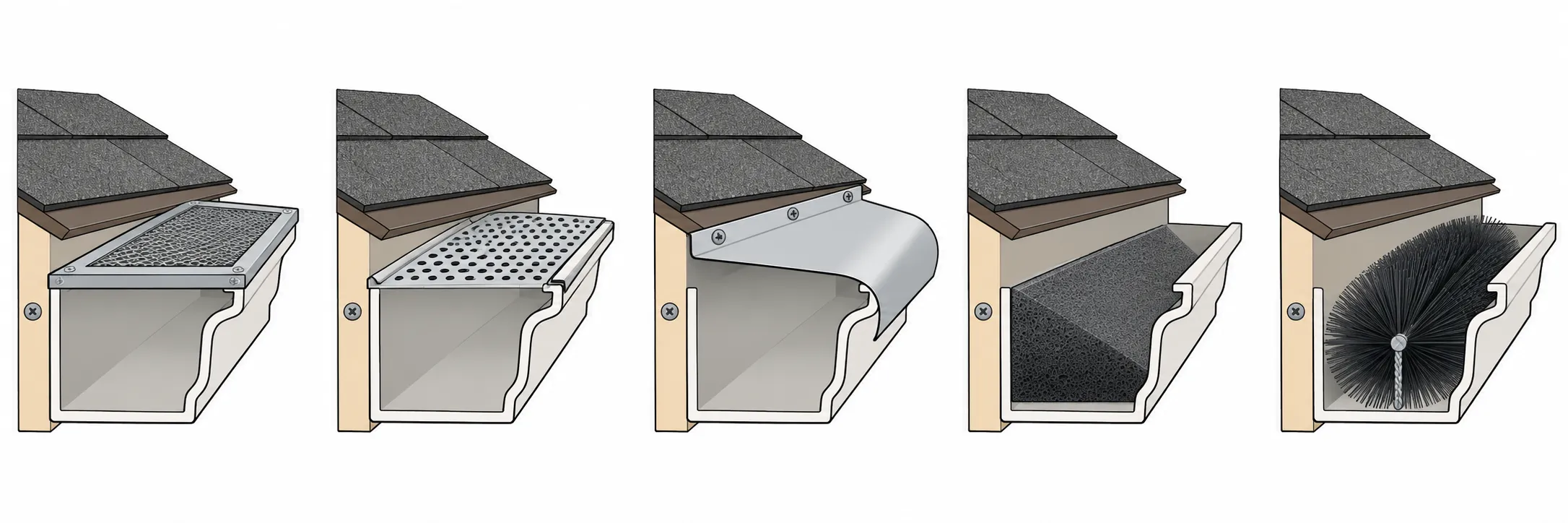
If you are not sure, check your paperwork from the installer, or take a photo from a window or the ground and ask the company that put the guards in.
How to Clean Gutters With Gutter Guards
The safest way to clean gutters with gutter guards is to start from the ground and only go further if you need to.
Start from the ground
For most mesh and screen guards on a one-story section of roof, a garden hose with a gutter-cleaning wand attachment does the job.
-
Clear what sits on top. A soft-bristle brush on an extension pole will sweep loose leaves and needles off the guard.
-
Rinse the surface. A gentle spray from the hose washes off pollen, sand and grit. Keep the pressure low: a pressure washer can bend fine mesh and push water up under the shingles.
-
Watch it drain. Run water onto the guard and check that it goes into the gutter and comes out the bottom of the downspout.
If rain has been running over the front of your guard instead of through it, a film of pollen or grime on the mesh is the usual cause. A gentle rinse and a soft brush normally clear it.
When the gutter underneath needs cleaning
Guards keep out the big debris, but fine material can still settle inside the gutter over the years. Signs it is time: water still overflows after the guard surface is clean, or the downspout barely drips during heavy rain. At that point the guards need to come off, the gutter needs cleaning, and the guards need to be put back securely. On a two-story house, or on any roof you cannot reach safely from a well-placed ladder, that is a job for a professional.
Before you lift or unscrew a guard
Many mesh guards are screwed into the gutter or tucked under the bottom row of shingles. Lifting them the wrong way can bend the frame, crack a shingle or affect the guard’s warranty. Before you remove anything, check your warranty paperwork and ask the company that installed the guards. And never work on a ladder when the roof or ground is wet, in strong wind, or near power lines.
A Simple Gutter Guard Maintenance Routine
The right gutter guard maintenance routine depends mostly on the trees around your house. Find the row that matches yours.
|
Your house |
Clean the guard surface |
Also check |
|
Mostly open sky, few trees nearby (common near the beaches) |
Once a year, in spring after the pollen |
Fasteners and edges after any big storm |
|
Oaks or maples nearby |
Once a year, in late November or early December after the leaves are down |
Downspouts at the same time |
|
Pine trees over or near the roof |
Twice a year, in spring and late fall |
Ends and corners, where needles collect |
|
Any house, after a nor’easter or other strong wind |
— |
Walk around and look for lifted edges or loose sections |
Whatever your row, look at the guards from the ground during a heavy rain once or twice a year. Water running neatly into the gutter means they are working. Water sheeting over the front means they need attention. For homes without guards, our guide on how often to clean your gutters covers open gutters.
Signs Your Gutter Guards Need Repair, Not Just Cleaning
Cleaning will not fix a guard that is damaged or loose. Look for these from the ground, especially after a storm:
-
A lifted or loose edge, where the guard no longer sits flat against the gutter or under the shingles
-
Bent or dented mesh, often from a falling branch or someone leaning a ladder against it
-
Gaps at corners and ends, where leaves and needles can get past the guard
-
Sections that have come apart, or screws that have backed out
-
Rust stains or streaks around fasteners, a sign that salt air is getting to them
-
Water overflowing even after a cleaning, which can mean the guard or the gutter underneath has shifted out of slope
Most of these are small repairs: re-seating a section, replacing a fastener or swapping out a damaged length of guard. Left alone, a loose guard can catch the wind in the next nor’easter. If you see any of them, have your gutter guards checked by a professional.
How Long Do Gutter Guards Last?
How long gutter guards last depends mostly on the material. This Old House gives these typical ranges with proper maintenance: stainless steel more than 20 years, aluminum 15 to 20 years, and plastic or vinyl 5 to 10 years (This Old House). Foam and brush inserts wear out fastest and may need replacing every few years.
Four things shorten or extend that life on a Sussex County home:
-
Material: metal mesh and frames outlast plastic and foam, especially in strong sun.
-
Salt air: homes close to the ocean or the bays should check fasteners and frames more often.
-
Installation: a guard that is fastened securely and sits at the right angle takes wind much better than one that is loose or clipped on.
-
Maintenance: a guard left matted with wet leaves for months holds moisture against the gutter and wears faster than one that is rinsed once a year.
Your guard’s warranty is the best guide to how long the manufacturer expects it to last, so keep that paperwork somewhere you can find it.
What Gutter Guards Can’t Fix
Gutter guards keep debris out. They do not fix a gutter system that has other problems. If you have guards and still see overflow, the cause may be:
-
Gutters that are too small for the size of the roof
-
Gutters sloped the wrong way, so water sits instead of draining
-
Too few downspouts, or downspouts that are crushed or blocked at the bottom
-
Rotten fascia boards behind the gutter, so the whole system is pulling away
In those cases, the fix is the gutters and downspouts themselves, not the guards. With winter coming, it is also a good time to look at the roof edge above them; our guide to getting your roof and gutters ready for winter explains what to check.
The Gutter Pros is a family-owned gutter and roofing company based in Selbyville. If your guards are overflowing, coming loose, or you are not sure what you have, contact us and we will take a look at your guards and gutters together.